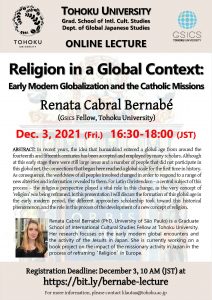
LECTURER:
Renata Cabral Bernabé (GSICS Fellow, Tohoku University)
DATE:
December 3, 2021 (Friday)
16:30-18:00 (JST)
Please register below for the Zoom link:
https://bit.ly/bernabe-lecture
(deadline: Dec. 3, 10 AM, JST)
※ The Lecture will be in English
ABSTRACT:
In recent years, the idea that humankind entered a global age from around the fourteenth and fifteenth centuries has been accepted and employed by many scholars. Although at this early stage there were still large areas and a number of people that did not participate in this global net, the connections that began here reached a global scale for the first time in history. As consequence, the worldview of all peoples involved changed in order to respond to a range of new alterities and information revealed to them. For Latin Christendom – a central subject of this process – the religious perspective played a vital role in this change, as the very concept of ‘religion’ was being reframed. In this presentation I will discuss the formation of this global age in the early modern period, the different approaches scholarship took toward this historical phenomenon, and the role in this process of the development of a new concept of religion.
ABOUT THE LECTURER:
Renata Cabral Bernabé (PhD, University of São Paulo) is a Graduate School of International Cultural Studies Fellow at Tohoku University. Her research focuses on the early modern global encounters and the activity of the Jesuits in Japan. She is currently working on a book project on the impact of the missionary activity in Japan in the process of reframing ‘Religion’ in Europe.
For more information, please contact klautau@tohoku.ac.jp