LECTURER:
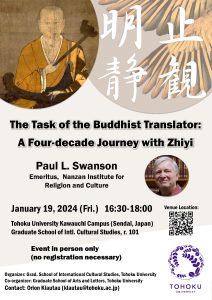
Paul L. Swanson (Emeritus, Nanzan Institute for Religion and Culture)
DATE:
January 19, 2024 (Friday)
16:30-18:00 (JST)
VENUE:
東北大学・川内北キャンパス
国際文化研究科棟 101会議室
Tohoku Univ., Kawauchi Campus
Grad. School of Intl. Cult. Studies, r.101
(For directions, please click here)
This English language event is open to anyone who is interested. Registration is not required(本講演は英語にて行われる。登録不要)。
ABSTRACT:
Celebrating over four decades of dedication to translating Chinese and Japanese Buddhist texts into English, Paul Swanson brings a wealth of experience to our upcoming event. Join us as he shares his insights into the “art” of translation and its challenges. Swanson will offer initial reflections on the creative process of translation. He will delve into the complexities of preparing two distinct translations of the same text – a fully annotated technical version for specialists, and a non-annotated straight translation for a broader audience. Swanson will also discuss the unique challenges associated with each type of translation. In addition, he will present specific examples from two pivotal works by the Tiantai patriarch Zhiyi (538-597) – the Mohe zhiguan 摩訶止観 and the Fahua xuanyi 法華玄義. These examples will showcase how Swanson has tackled various translation problems.
ABOUT THE LECTURER:
Paul L. Swanson is Professor Emeritus at the Nanzan Institute for Religion and Culture. He was born and raised in Japan. He did his graduate studies at Sophia University, the University of Tokyo, and the University of Wisconsin-Madison. His dual areas of specialization are Japanese Religions (Shugendo) and Buddhist Studies (Tiantai/Tendai Buddhism). His publications include: Foundations of T’ien-t’ai Philosophy, Pruning the Bodhi Tree, Nanzan Guide to Japanese Religions, Clear Serenity, Quiet Insight: T’ien-t’ai Chih-i’s Mo-ho chih-kuan, and In Search of Clarity: Essays on Translation and Tiantai Buddhism. In 2019, his monumental translation of Zhiyi’s work was awarded the Toshihide Numata Book Prize for Buddhism.
The event is organized by the Tohoku University Graduate School of International Cultural Studies (Dept. of Global Japanese Studies), and co-hosted by the Graduate School of Arts and Letters (Dept. of Innovative Japanese Studies).
For more information, please contact klautau@tohoku.ac.jp