Sensing with micromechanical structures
We use micro- and nanoscale mechanical structures to detect small changes in force, mass, temperature, humidity, gases, and magnetic fields.


Department of Mechanical Systems Engineering
Functional Systems Engineering, Mechanical Dynamics
Toda Laboratory develops advanced sensing systems based on semiconductor microfabrication, micro/nanomechanics, mechanical resonance, magnetic resonance, quantum sensing, and interfacial science. We aim to detect small signals and hidden phenomena that are difficult to access by conventional electrical or optical measurements alone, and to integrate them into practical systems.
Breakthrough sensing through the synergy of quantum effects and micromechanics
We regard micromechanical structures not only as miniature devices but also as physical interfaces that convert quantum, magnetic, and interfacial phenomena into practical signals. Deformation, vibration, and resonance of microstructures enable highly sensitive readout of force, mass, temperature, humidity, gases, magnetic fields, and interfacial charge or radical generation.
We use micro- and nanoscale mechanical structures to detect small changes in force, mass, temperature, humidity, gases, and magnetic fields.
We study sensors that read out small changes as frequency shifts or displacements using cantilevers and resonators.
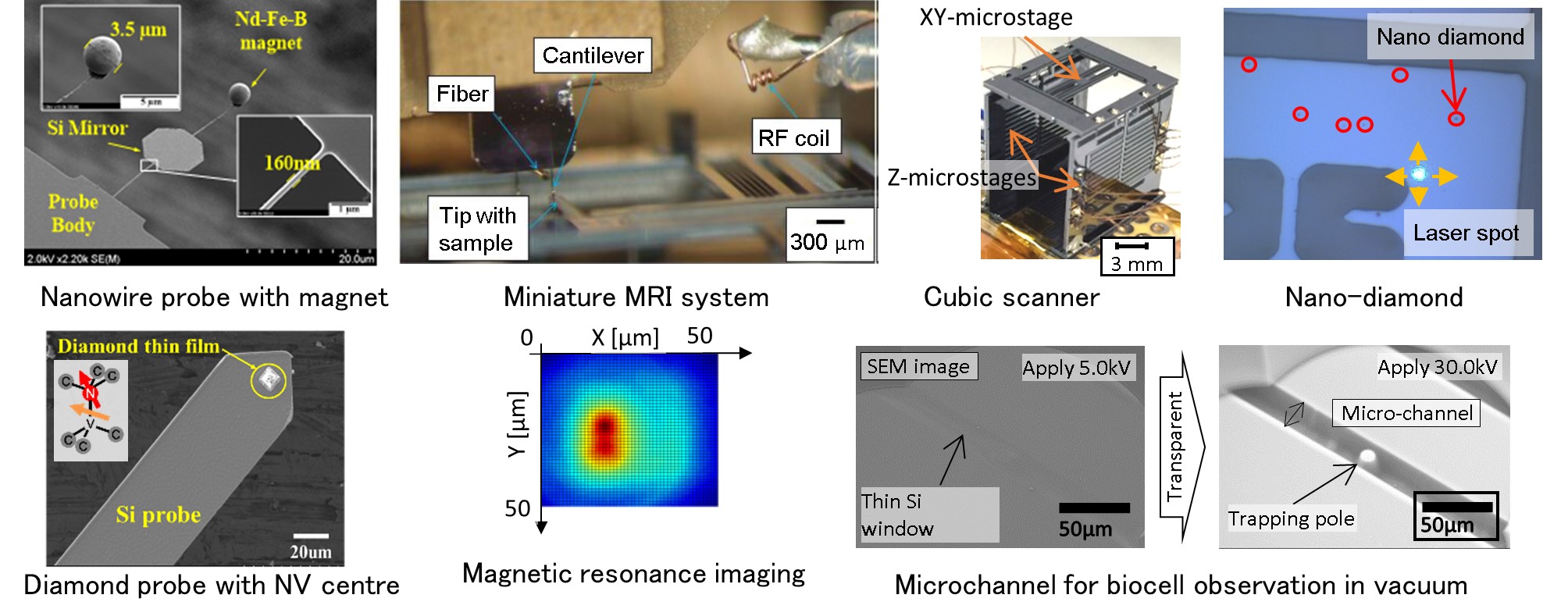
We combine quantum and spin measurements with micromechanics, including magnetic resonance force microscopy, ESR imaging, microfluidic NMR, and diamond NV centers.
We investigate charge transfer, radical generation, molecular interactions, triboelectric effects, and heat and mass transport at interfaces involving water, molecules, polymers, diamond, and solid surfaces.
Please contact us if you are interested in our research. Laboratory visits and consultations for prospective students are welcome.
Toda Laboratory
Department of Mechanical Systems Engineering, Graduate School of Engineering, Tohoku University
6-6-01 Aoba, Aramaki, Aoba-ku, Sendai 980-8579, Japan
Mechanical Engineering Building 1, Room 411 and Room 413